Press kit no. 1151-16
Journalists, explore this publication-ready project. Create a free v2com media account to download high-resolution images.
Create a media account
Press Kit | no. 1151-16
Manufacture
PietriArchitectes
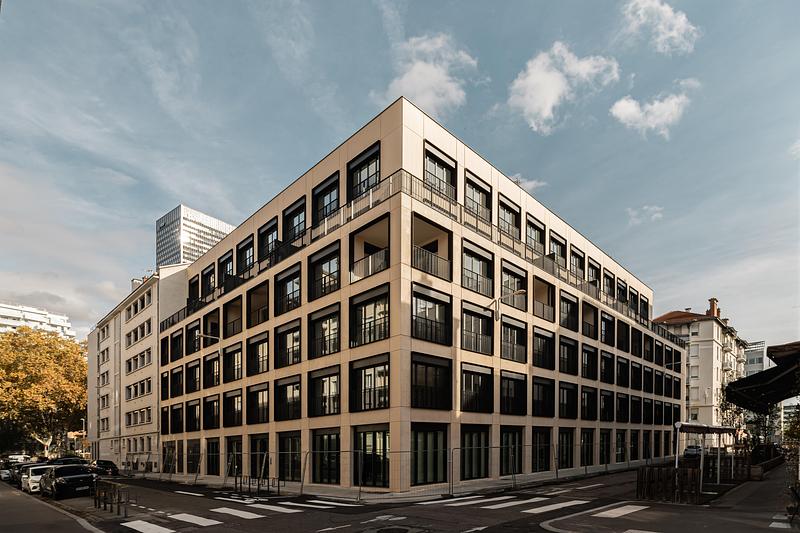
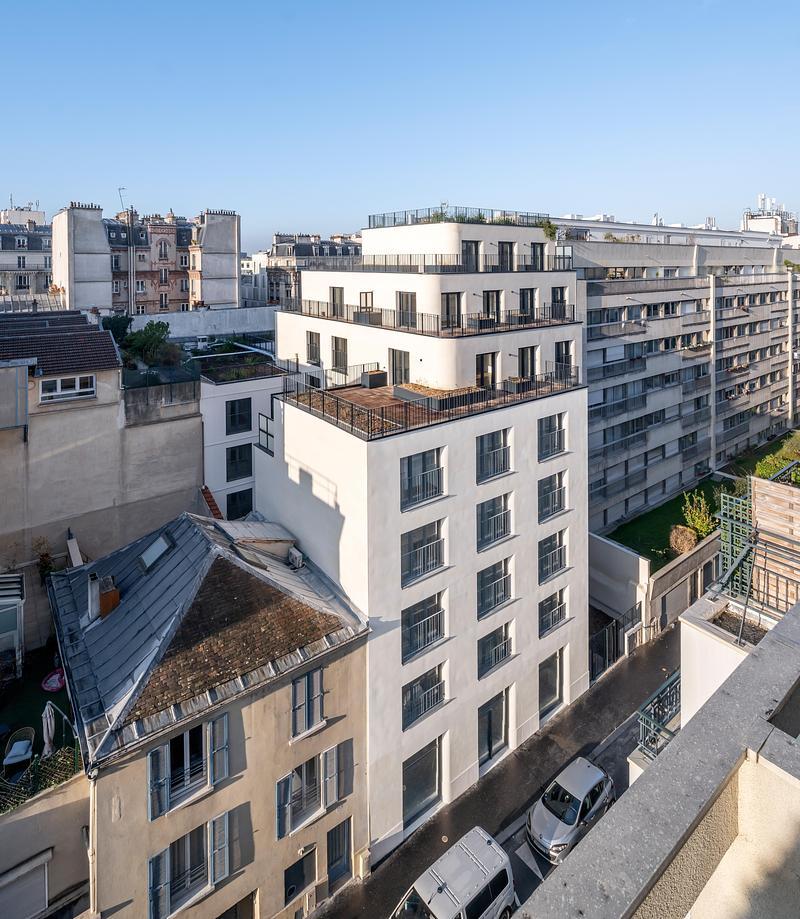
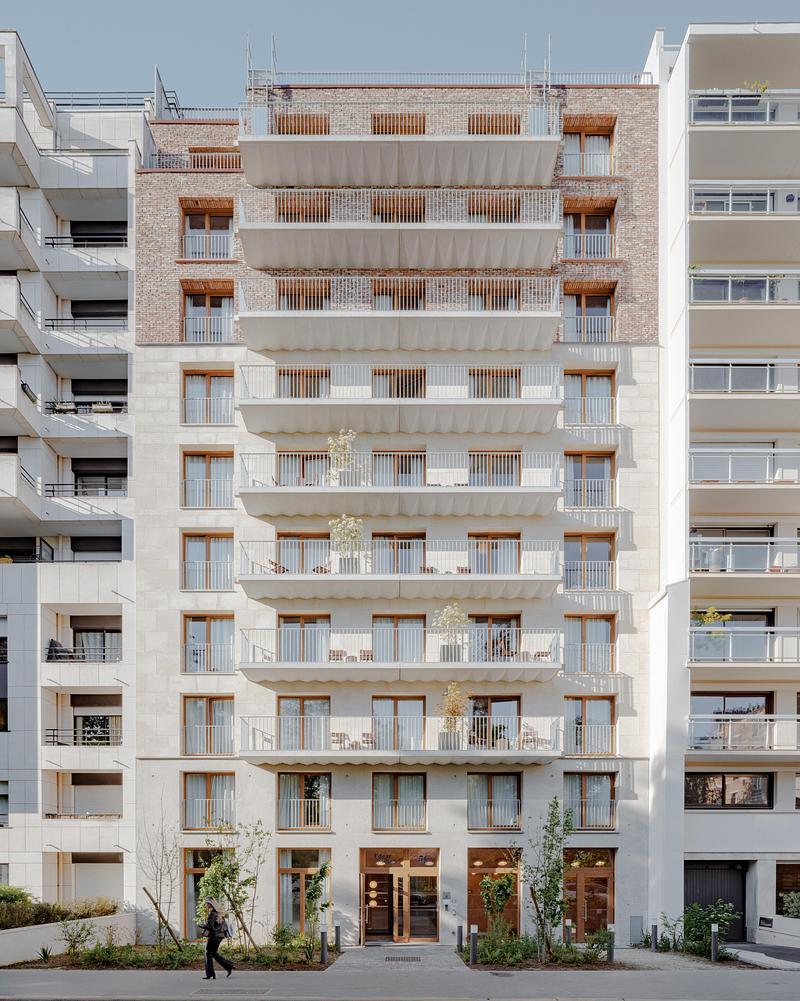
Located at the corner of Rue Danton and Rue des Rancy, in the heart of Lyon’s Part-Dieu district, this project is part of a contemporary urban dynamic, while embracing a strong industrial heritage. Its name draws inspiration from the history of Lyon, a city emblematic of manufacturing and historic factories, where the structural framework was at once rational, legible, and durable. Like these industrial buildings, the structure features a form that tapers gradually up to the fifth floor, asserting a simple and cohesive identity, supported by a unified framework that brings together all functions and facades.
The unified grid is the project’s founding principle. It structures the building’s framework, its façade design, and the organization of all its functions. Conceived as a generic, repetitive system, this grid accommodates three distinct functions—retail, residential, and office—without disrupting the architectural style. The building is thus conceived as a coherent and legible whole, where programmatic diversity is integrated into a single structural logic.
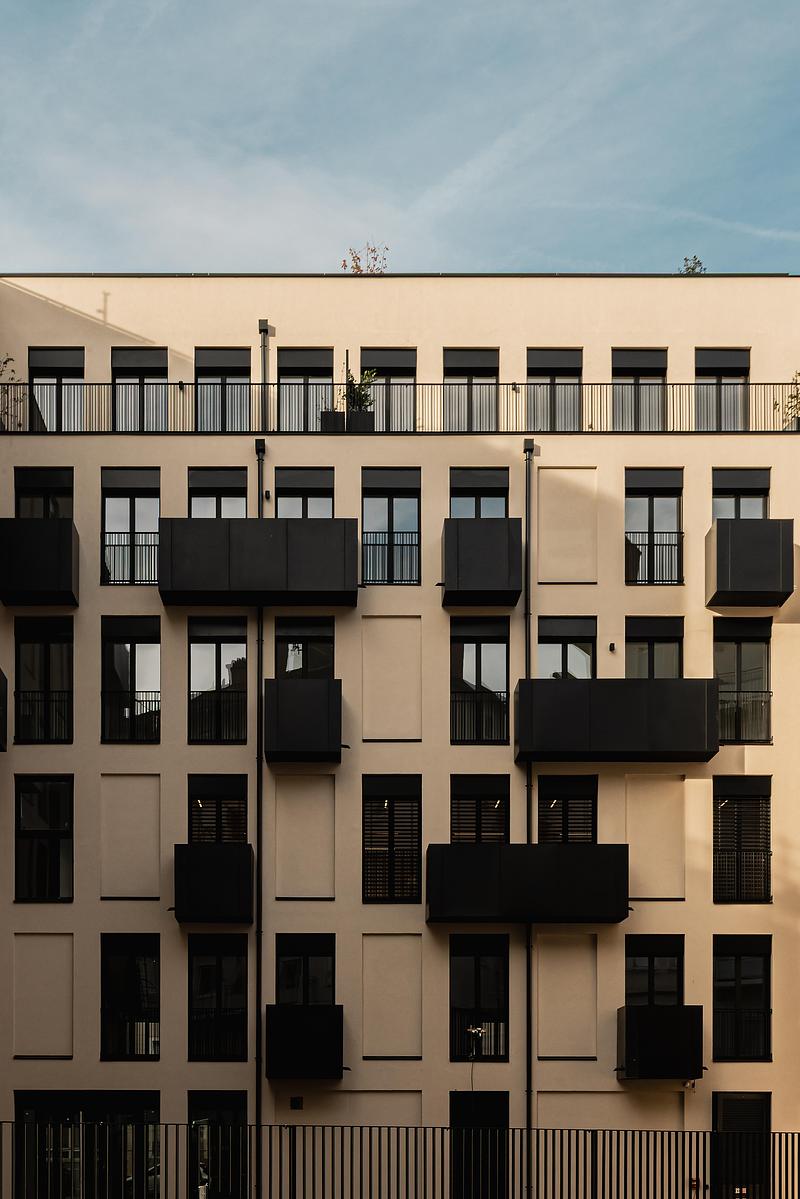
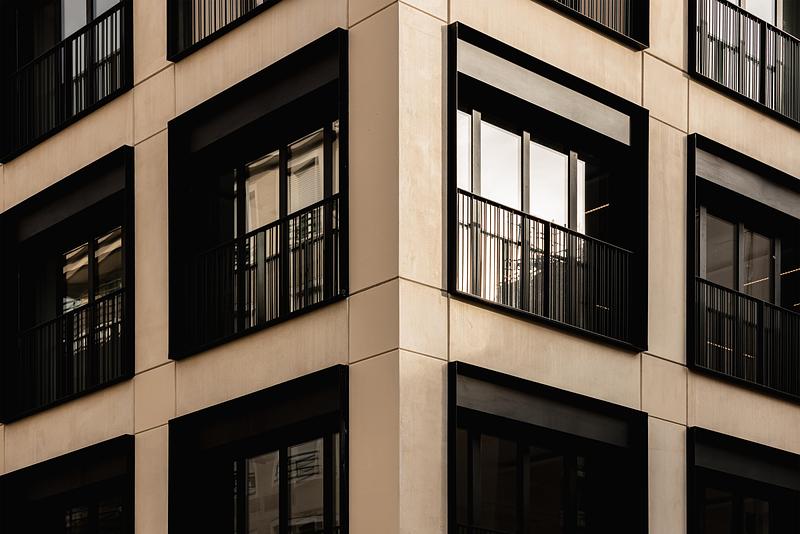
On the facade, the repetition of identical openings creates a regular, controlled rhythm, where the architectural expression reflects the structure without revealing the interior use. The grid becomes a common language, capable of standing the test of time without losing its relevance, much like the renovations in Soho.
Spatially, the structural grid generates modular floors that can be easily divided or reconfigured as needed. The retail spaces on the ground floor benefit from this approach through clear and flexible layouts, while the upper floors house residential units and offices within a shared framework conducive to functional diversity.
This unique grid is also reflected in the building’s relationship to the site. On the inner block side, the interior facade—featuring solid panels over openings—establishes a different rhythm: a denser, more controlled design that creates a tension between interior and exterior, emphasizing a deliberate contrast between the built mass and open spaces. The gradual setback of the building, integrated into the rhythm of the grid, allows for the creation of terraces, hanging gardens, and accessible rooftops, offering scenic respites and improved natural light.
The office design is fully integrated into the single structural grid and maximizes its adaptability. The load-bearing system relies exclusively on regularly spaced columns, freeing the floor plates from any interior load-bearing walls. This open structure allows for great flexibility in layout and makes it possible, in the long term, to convert the offices into residential units without major structural modifications.
The grid dimensions were designed to simultaneously meet the requirements of both commercial and residential use: floor depth compatible with natural lighting, and a facade rhythm adapted to housing layout. This forward-thinking approach allows the building to adapt to changing work and living patterns while maintaining the architectural coherence of the structure.
By incorporating this reversibility from the design phase, the project offers a sustainable response to the contemporary challenges of the dense city. It limits the planned obsolescence of office buildings and provides long-term adaptability without altering either the structure or the building’s image. The single framework thus becomes a true tool for urban resilience, serving an architecture capable of evolving with the needs of the city of Lyon.
Technical sheet
Project: 26 housing units, retail spaces, and convertible office spaces
Client: Constructa, Vinci Immobilier
Architect: PietriArchitectes
Environmental norms: NF Habitat HQE excellent level / Ready to Osmoz / Wiredscore
Area: 4 142 m²
Cost: €6.9 million
Completion: December 2025
About PietriArchitectes
Jean-Baptiste Pietri, an architect who graduated from the Paris-Belleville School of Architecture, founded his firm, PietriArchitectes, in Paris in 2001. He has two partners: Jérémy Louette and Sarah Leroux. Based in Paris’s 8th arrondissement, PietriArchitectes has approximately 20 employees.
The firm's founder has an architectural approach that is both precise and poetic, built and developed around a philosophy: romantic rationalism. This concept combines a rigorous and optimized construction design with a rather expressive interpretation of the site. Far from rigid formalism, this approach seeks to create spaces that are both rigorous and poetic, rooted in their era, while cultivating a certain timelessness. The architect must inspire dreams, but his works must be demanding, like his high-rise buildings, which have been a recurring theme in Jean-Baptiste Pietri’s work since his diploma project.
PietriArchitectes stands out for its ability to work on architectural projects of all sizes. The firm builds throughout France, which allows it to establish a unique identity and universe thanks to its architectural vocabulary, whose style adapts to the context in which it is used, while deploying its own distinctive style. From single-family homes to high-rise buildings, hotels, and HQE housing, each project reflects meticulous attention to its use. This cross-disciplinary approach allows the firm to assert a coherent architectural vocabulary while adapting its style to the specificities of each program.
Striking a perfect balance between North and South, Jean-Baptiste Pietri and his collaborators stand out for their fluid lines, rounded shapes, and subtle materials, always seeking a balance between innovation and integration. Far from any brutality, his architecture cultivates a genuine urban politeness, seeking to engage with its environment without sacrificing a sensitive and expressive dimension.
For more information
Media contact
- PietriArchitectes
- Sarah Leroux
- bureau@jbpa.fr
- +33 (0)1 44 78 68 48
Attachments
Terms and conditions
For immediate release
All photos must be published with proper credit. Please reference v2com as the source whenever possible. We always appreciate receiving PDF copies of your articles.
Very High-resolution image : 17.79 x 26.67 @ 300dpi ~ 12 MB
Very High-resolution image : 26.67 x 17.78 @ 300dpi ~ 14 MB
Very High-resolution image : 26.67 x 17.79 @ 300dpi ~ 12 MB
Advertising
You may also like...

Céragrès Studio: From Concept to Material. A New Destination for Design.
Discover Céragrès Studio: a brand-new space in the heart of Mile-Ex, bringing together materials, furniture, and expertise. Designed as a true resource hub for design and architecture professionals, the Studio offers an evolving material library, a space for exploration, and a network of collaborators dedicated to bringing your projects to life.


Paris, France, 2023-01-24
A Project in the Heart of Massy Vilgénis Forest Signed by Pietriarchitectes
PietriArchitectes

Paris, France, 2022-12-05
PietriArchitectes rehabilitates a residential building and builds a wooden extension
PietriArchitectes

Paris, France, 2022-11-03
PietriArchitectes Delivers a New Building for Romainville
PietriArchitectes



New York, United States, 2026-09-09