Press kit no. 5881-06
Journalists, explore this publication-ready project. Create a free v2com media account to download high-resolution images.
Create a media account
Press Kit | no. 5881-06
Press release only in English
City Tech Pearl Building
Shakespeare Gordon Studio
Adaptive reuse projects bring their share of complications, yet as aging systems are stripped away, long-quiet details often emerge with unexpected resonance. As Shakespeare Gordon Studio (SGS) began the design process for a gut renovation at New York City College of Technology (NYCCT), such discoveries began to reveal themselves. NYCCT, commonly referred to as City Tech, is in heart of what has become known as the "Brooklyn Tech Triangle". This project is an initiative spearheaded by various local economic development organizations that includes over 500 tech companies and 11 universities in and around downtown Brooklyn, comprising the largest innovation cluster outside of Manhattan. At the heart of the campus is the New Academic Complex, a 350,000-sf multipurpose academic building that was completed in 2019. This new building serves as a centerpiece of academic life on City Tech’s campus, and a new landmark in downtown Brooklyn that reinforces its growing role as an economic and cultural contributor to the city.
However, with the New Academic Complex adding much needed space for City Tech’s growing academic programs, the college’s older facilities, located just across Jay Street, were newly vacant and ready for much needed renovations after years of overuse and crowding. SGS joined the project to focus attention across Jay Street, to reimagine one of City Tech’s oldest spaces, the Pearl building, as a contemporary, dignified space for the College to continue expanding its operations across downtown Brooklyn.
Since 2018, SGS has undertaken several projects in or related to the Pearl Building, a six-story multipurpose academic building. Built in 1922, the Pearl Building served as a munitions factory until it was repurposed by the newly established New York City College of Technology in the 1940s. The building’s previous use as a factory defines its underlying layout and structural typology: the building features an expansive floorplate with high ceilings supported by a sturdy concrete frame, wrapped with large windows, and dotted throughout with thick structural columns clad in concrete. Along with the building’s age also came complications with its dated infrastructure, which was an especially pertinent problem for a college hoping to accommodate advanced scientific and technological education. Each of these characteristics would come to play a central role in SGS’s design.
SGS’s involvement in the Pearl Building began with a master plan that included layout options and test fits, estimated construction costs, and a detailed review of the existing conditions to be addressed. Out of this master plan came a renovation project focused on the building’s 3rd floor, a 17,000-sf space previously used for a mix of purposes, including scientific labs, offices, and ancillary functions. With several department offices, teaching labs, and classrooms relocated from the Pearl Building to the New Academic Complex, the renovated 3rd floor is now home to four administrative office units, each with its own unique design identity, and linked by a common corridor connecting to a shared conference suite and support spaces.
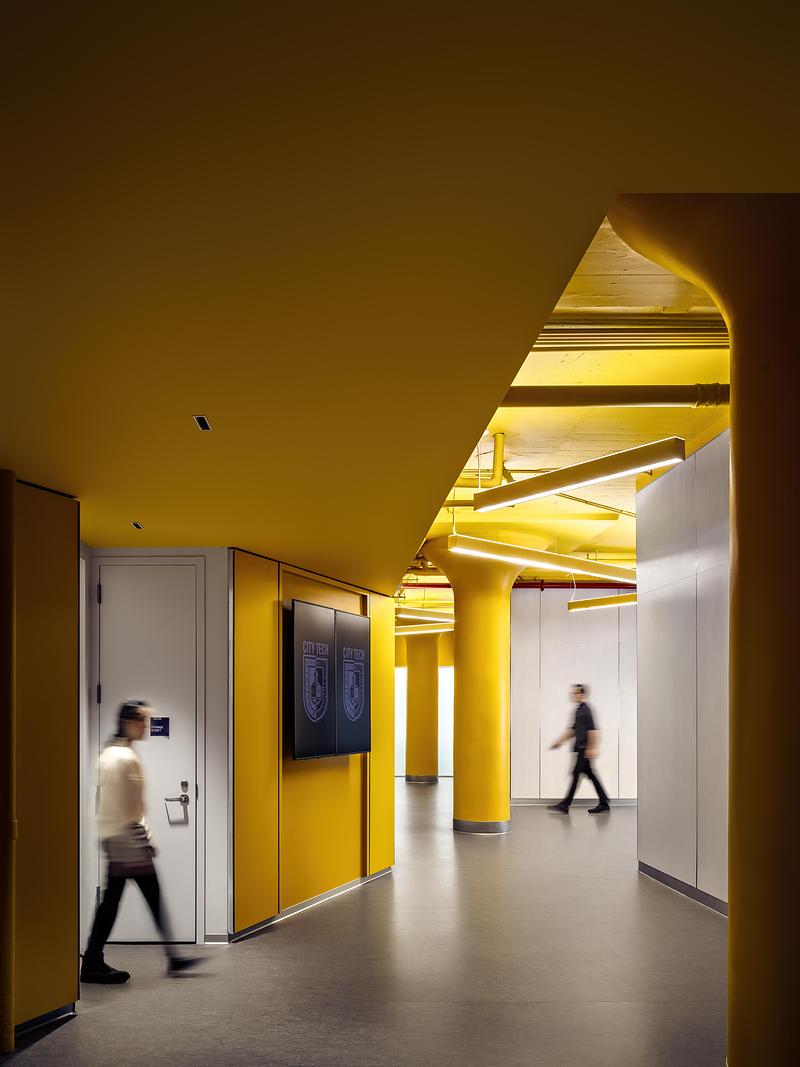
The experience of the 3rd floor begins as users enter the elevator lobby, covered with a comforting and lively shade of yellow paint across the walls, ceilings, and newly exposed structural columns: a relic of the building’s history that showcases its strong, yet elegant structural systems. Playful lighting design mixed with bright colors illuminates this otherwise dark corner of the building, warmly inviting guests into the space and establishing design motifs that continue across the floor.
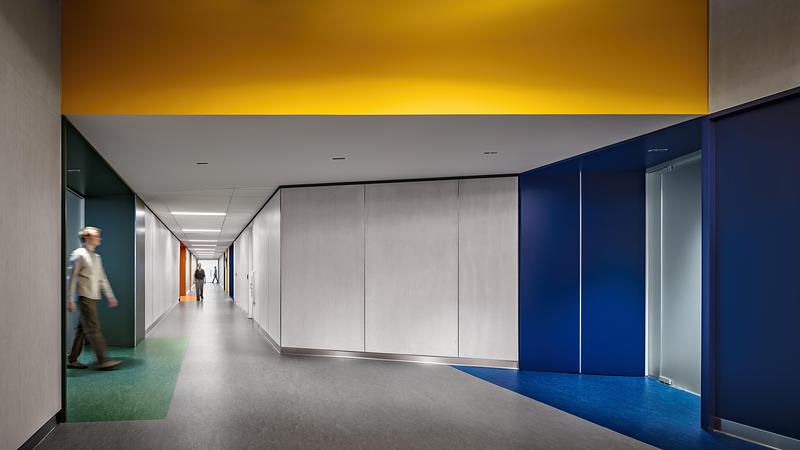
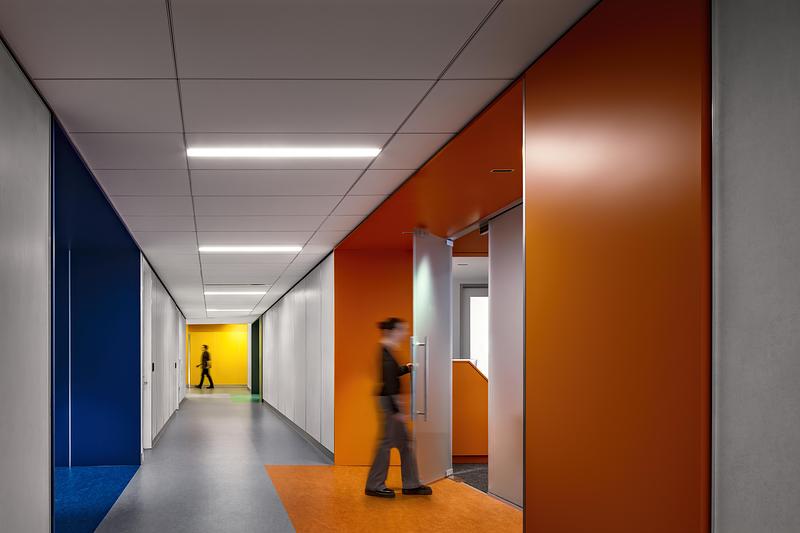
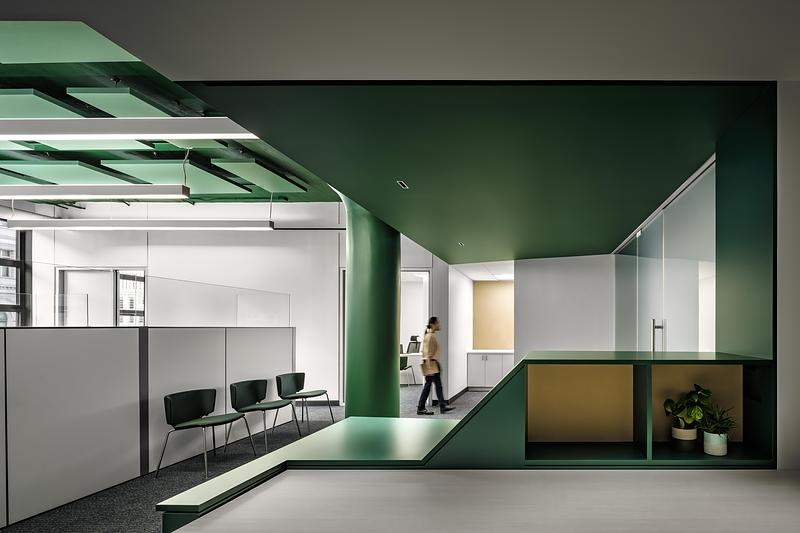
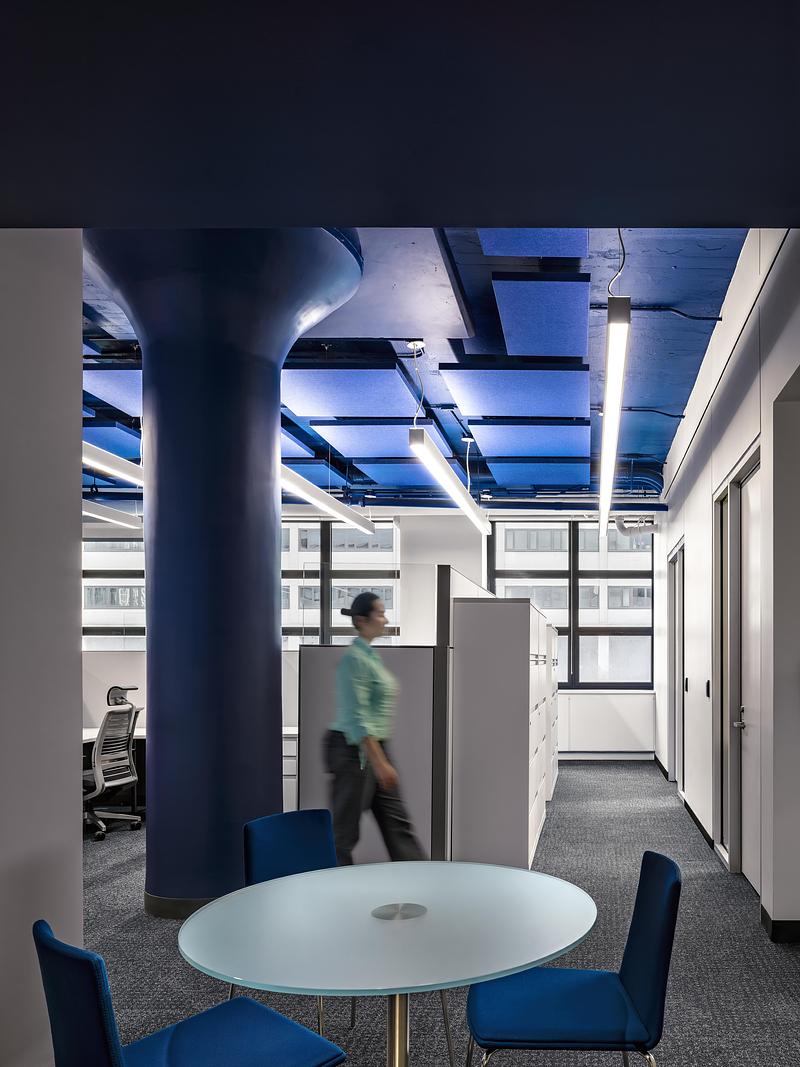
Beyond the elevator lobby, users are ushered into the central spine of the 3rd floor, a long, wide hallway that extends the length of the building. Looking down the length of the hallway, users see a pleasant palette of bright colors—green, blue, orange, and purple—each representing the assigned visual identity of a different administrative suite. These colors, which predominate the interiors of each suite, extend outward into the hallway’s floor, adding new dimensions and a clever system of wayfinding to an otherwise blank and rectilinear space.
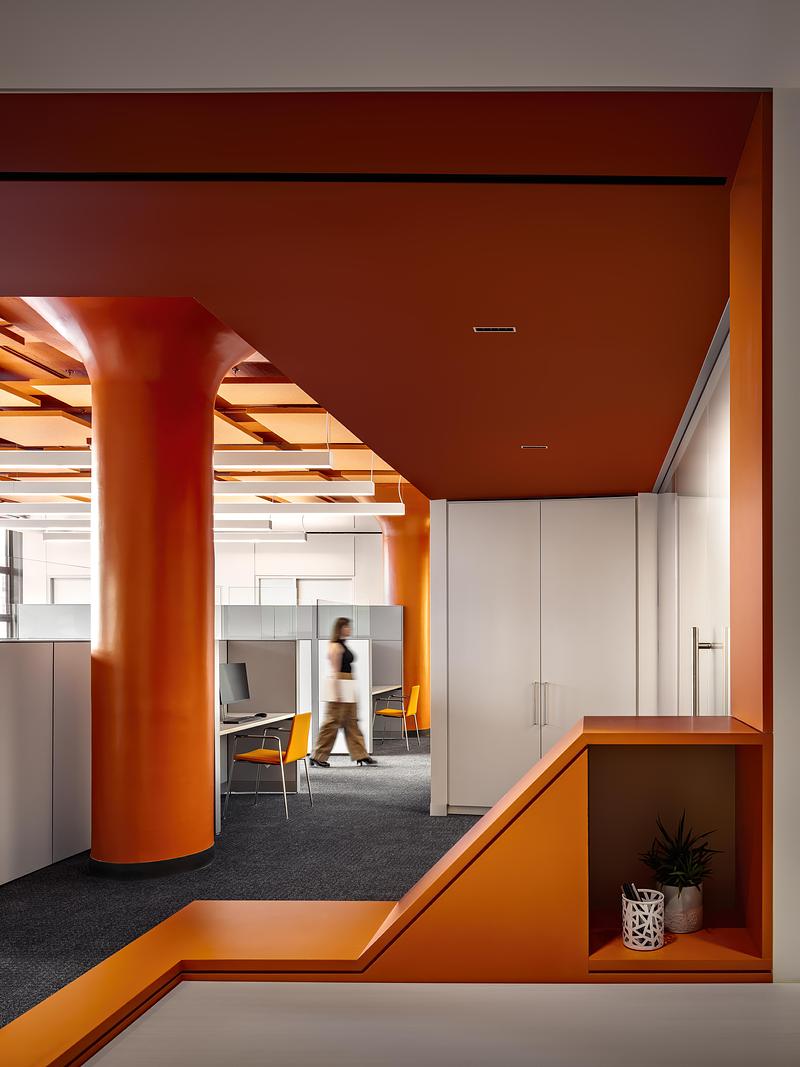
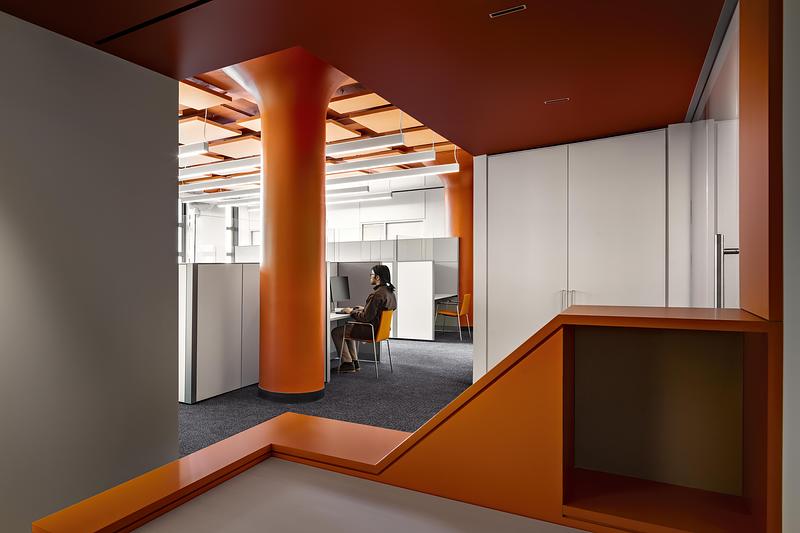
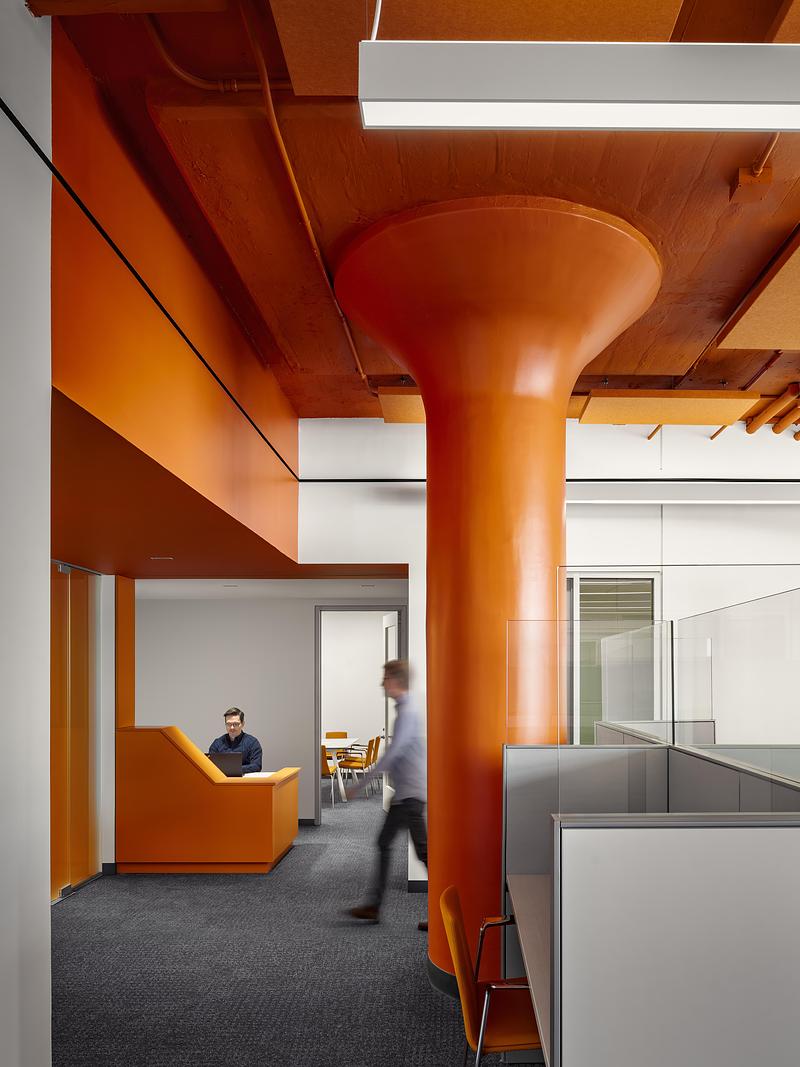
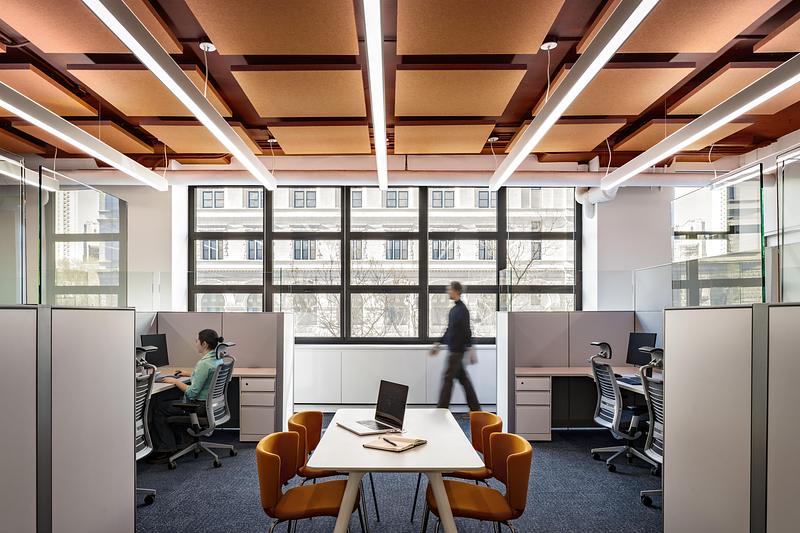
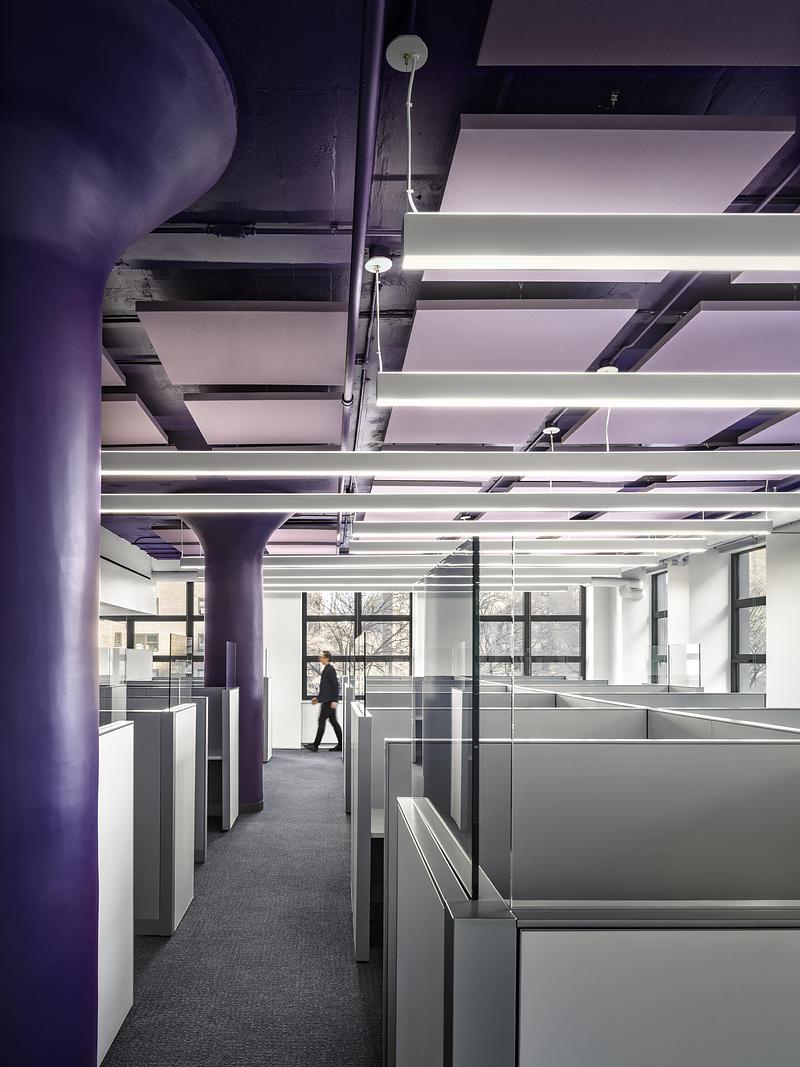
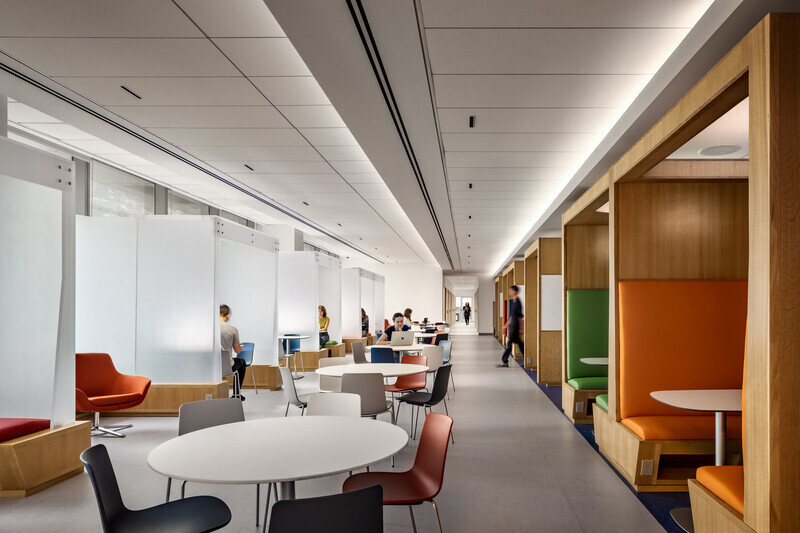
Inside the suites, the plan makes the best use of the building’s expansive floor plate, while ensuring that occupants are never far from views, natural light, and a relationship to the city beyond. The building’s concrete curtain walls, a remnant of its origins as a factory, allow for large, abundant windows along the exterior of each suite. A mix of private offices and open plan areas delivers a variety of workstations, allowing for flexibility and modularity as uses change and adapt with future College programming. Within each suite, a grid of familiar columns punctuates the open space, serving as more than just structural support for the building, but also as a distinctive aesthetic feature that defines the identity of the third floor. Color-coded acoustic panels line each of the suite’s ceilings, combining with the bright visual aesthetics of each space while simultaneously ensuring the acoustic comfort of each room.
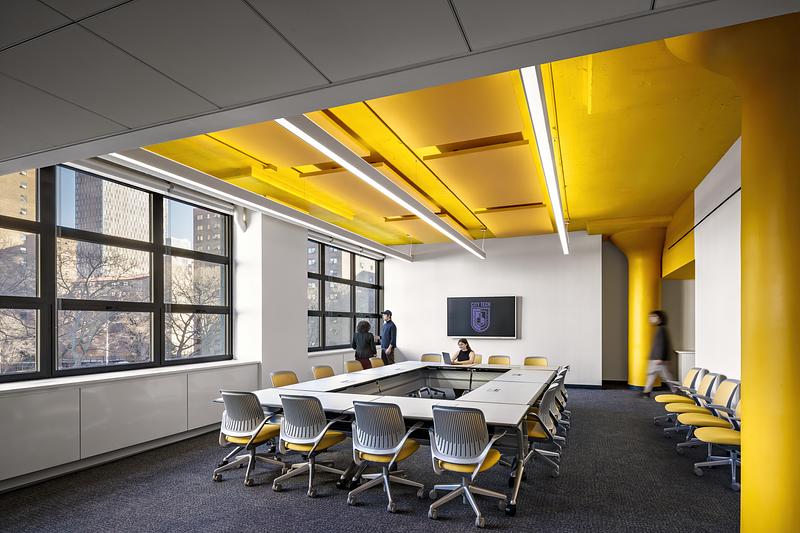
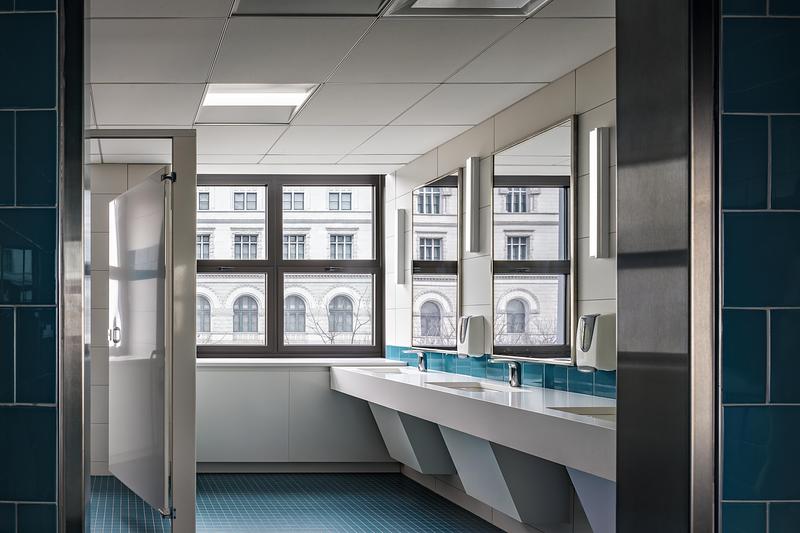
Outside of the third floor’s office suites is a shared conference room at the end of the central spine, as well as newly expanded ADA-accessible bathrooms. Due to the Pearl Building’s previous use as lab spaces, this project also included extensive hazardous material abatement, as well as all new building systems, AV/IT design, and a completely new layout. In addition to being the architect, SGS provided furniture, lighting, and graphic design services.
This project showcases the potential that often lies hidden in an old building. Once a maze of disconnected rooms that were dark, crowded, and overused, this elegant renovation reveals the building’s inherent qualities to make bright, colorful, and contemporary spaces, even in a building that is more than century old. The large, open floor plans of this ex-factory lent themselves to expansive layouts, curtain walls allowed large windows to spread light throughout office suites, and hefty structural columns turned from a design constraint into a consistent visual motif.
As the newly coined Tech Triangle continues to expand its influence across downtown Brooklyn’s built environment, architects and developers should turn their attention to adapting the neighborhood’s existing building stock: historic buildings with structural capabilities for bright, expansive, and contemporary spaces.
Technical sheet
Official Project Name: City Tech Pearl Building
Location: Brooklyn, New York
Client: New York City College of Technology, (NYCCT), Dormitory Authority of the State of New York (DASNY)
Architect: Shakespeare Gordon Studio
Consultants:
Loring Consulting Engineers
LERA Consulting Structural Engineers
Matrix New World Engineering
VJ Associates
J Callahan Consulting
Square Footage/units: 17,000 sf
Project Completion Date: 2025
Photographer: Alexander Severin Architectural Photography
About Shakespeare Gordon Studio (SGS)
Shakespeare Gordon Studio (SGS) is an NYC-based, certified woman-owned business (WBE) that offers inventive and thoughtful solutions to design challenges at all scales for a wide variety of clients and project types. Originally established by Amy Shakespeare in 2003, SGS has expanded and evolved its foundational principles over the course of more than twenty years, with Mark Gordon joining Amy as Principal in 2016. Previously known as SGVA, the firm's work emphasizes design excellence, a commitment to the improvement of their city’s built environment, and dedicated service to their clients.
SGS has designed and built affordable housing, offices, clinics, university facilities and research laboratories, residential developments, and private homes. The Studio's projects include feasibility studies, partial and full building renovations, and new, ground-up construction at all scales.
For more information
Media contact
- Shakespeare Gordon Studio
- Amy Shakespeare, Principal
- admin@sg.studio
- 2128223200
Attachments
Terms and conditions
For immediate release
All photos must be published with proper credit. Please reference v2com as the source whenever possible. We always appreciate receiving PDF copies of your articles.
Very High-resolution image : 20.0 x 26.67 @ 300dpi ~ 61 MB
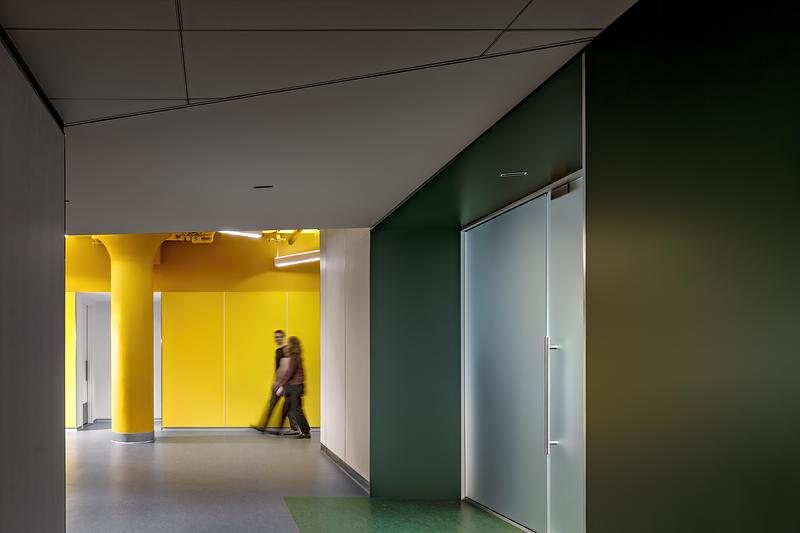
| The design includes a material and color palette that is customized for each administrative entity’s suite, providing a sense of identity and wayfinding for all users. |
Very High-resolution image : 33.33 x 22.22 @ 300dpi ~ 67 MB
Very High-resolution image : 33.33 x 18.75 @ 300dpi ~ 78 MB
Very High-resolution image : 33.33 x 22.22 @ 300dpi ~ 81 MB
Very High-resolution image : 20.0 x 26.67 @ 300dpi ~ 60 MB
Very High-resolution image : 33.33 x 22.22 @ 300dpi ~ 84 MB
Very High-resolution image : 20.0 x 26.67 @ 300dpi ~ 64 MB
Very High-resolution image : 33.33 x 22.22 @ 300dpi ~ 110 MB
Very High-resolution image : 33.33 x 22.22 @ 300dpi ~ 100 MB
Very High-resolution image : 33.33 x 22.22 @ 300dpi ~ 75 MB
Very High-resolution image : 20.0 x 26.67 @ 300dpi ~ 69 MB
Very High-resolution image : 20.0 x 26.67 @ 300dpi ~ 66 MB
Very High-resolution image : 33.33 x 22.22 @ 300dpi ~ 88 MB


Advertising
You may also like...

Céragrès Studio: From Concept to Material. A New Destination for Design.
Discover Céragrès Studio: a brand-new space in the heart of Mile-Ex, bringing together materials, furniture, and expertise. Designed as a true resource hub for design and architecture professionals, the Studio offers an evolving material library, a space for exploration, and a network of collaborators dedicated to bringing your projects to life.


Toronto, Canada, 2026-10-21
De La Salle College John Hunt Student Life Centre
Moriyama Teshima Architects
Montreal, Canada, 2026-10-15
KANVA Unveils the Parc Marie-Victorin Museum: Inhabiting the Topography to Reveal a Heritage Forged by Time
KANVA
Montreal, Canada, 2026-10-13
Le Grand-Espace Sherbrooke: A New Cultural Venue
Atelier Paul Laurendeau | NEUF architectes
Montreal, Canada, 2026-09-10
Eglinton Crosstown LRT : Elevating the Quality of Design in the Public Realm
Daoust Lestage Lizotte Stecker Benech
Los Angeles, United States, 2026-09-02
StudioHAU Completes Extensive Renovation and Redesign of the Berkshire Museum’s First Floor Galleries, Aquarium and Public Spaces
StudioHAU
Toronto, Canada, 2026-08-12
McMaster University Life Sciences Building and Greenhouse
Moriyama Teshima Architects
Philadelphia, United States, 2026-08-12
VMA Brings Lincoln University’s Cresson Hall Back to Life
Voith & Mactavish Architects, LLP (VMA)