Dossier de presse no. 7916-01
Journalistes! Découvrez ce projet prêt à publier. Créez gratuitement un compte média v2com pour télécharger les images haute résolution.
Créez un compte média
Dossier de presse | no. 7916-01
Communiqué seulement en anglais
Rooted in Culture: The Muscowpetung Powwow Arbour Wins Architizer A+ Award and Canada's Governor General’s Medal in Architecture
Oxbow Architecture & Richard Kroeker
Oxbow Architecture & Richard Kroeker's culturally grounded design is recognized on both the national and international stage.
Oxbow Architecture, in collaboration with Richard Kroeker, is proud to announce that the Muscowpetung Powwow Arbour has received two of architecture's most prestigious honours: the Architizer A+ Award and the 2026 Governor General's Medal in Architecture, presented by the Royal Architectural Institute of Canada (RAIC) and the Canada Council for the Arts. This recognition belongs to Muscowpetung Saulteaux Nation. Its success demonstrates the commitment of Muscowpetung's Leadership to its people and is a result of the careful guidance of Muscowpetung's Myke Agecoutay and Jeff Cappo.
Located on Treaty 4 territory in southern Saskatchewan, the Muscowpetung Powwow Arbour is a vibrant cultural gathering place rooted in Saulteaux tradition and community renewal. Designed as the centrepiece for summer powwow celebrations, the structure draws inspiration from Saulteaux material culture and the symbolic importance of the circle. Its clear-span circular form, informed through extensive Elder consultation, recalls traditional lodges while creating a lightweight roof that appears to float on the prairie horizon.
The project's purpose is to strengthen traditions, celebrate culture, and encourage community members to pass along knowledge to future generations. The building design was established through community and band leadership consultation, most notably with local knowledge keeper Jeff Cappo. The completed arbour spans 1,275 square metres, accommodating up to 2,500 spectators and 1,000 dancers.
Architecture That Gives Back
The project supports community economic objectives by engaging local sources of labour in the building process, with construction approaches strategically aligned with local resources and skills. A regenerative development in every sense, the Arbour reflects the Saulteaux concept of Mino-pimatisiwin — "live a good life" — and responds directly to both the climate crisis and the needs of the Muscowpetung community.
Built with regionally sourced round timber and local labour, the Arbour reflects traditional knowledge through climate-responsive, resource-efficient construction. Open at its centre, the conical roof admits light to sustain the grasses below, blending landscape and architecture.
Beyond its architectural significance, the Arbour serves as a cultural anchor supporting family wellness, education, and community gathering. Surrounded by restored native prairie, the project demonstrates regenerative design, with ecological restoration and carbon sequestration supporting carbon neutrality while strengthening cultural continuity for generations to come.
Technical sheet
Name of lead architects
Oxbow Architecture (Brad Pickard) & Richard Kroeker
List of contributing team members from each architecture firm
Richard Kroeker
Oxbow Architecture
Andrea Clayton
Anna Ringstrom
Ashley Graf
Brad Pickard
Jim Siemens
Jordyn Loy
Mason Loy
Megan Florizone
Meghan Taylor
Rory Picklyk
Sam Lock
Sarah Robertson
Tanis Worme
Project name
Muscowpetung Powwow Arbour
Project address
Muscowpetung Saulteaux Nation, Saskatchewan, Canada
Project client
Muscowpetung Saulteaux Nation
Interior area and, if relevant, exterior area, in square metres
1,222 m2 (outer extent of roof circumference)
61,590m2 (land area conversion to native perennial vegetation from conventional agricultural land use)
Occupation date of the project
August 18, 2025
A list of all key consultants to be credited:
Structural engineer: Wolfrom Engineering
Electrical engineer: Ritenburg & Associates
Timber Structures Specialist: Chris J. K. Williams
Sustainability Consultant: Ha/f Climate Design
Architectural Photography: Lindsay Reid
Powwow Dancer Photography: Chris Ross
Context
Saskatchewan's carbon-intensive electrical grid presents a significant operational emissions challenge — building operations in the province can produce up to 700% more CO₂e than equivalent buildings in Canada’s provinces such as Ontario, where hydroelectric and nuclear power dominate the grid. The Muscowpetung Powwow Arbour delivers an unconditioned cultural building that looks at passive strategies for achieving thermal comfort for the three seasons (spring, summer, fall) where land-based cultural activities take place. The resultant climate responsive design, guided by traditional Saulteaux knowledge and resource stewardship practices, shifts it’s focus entirely to embodied carbon reduction and regenerative landscape strategies to achieve carbon neutrality within a 5 year period.
Whole Life Cycle Assessment
A whole life cycle assessment (WLCA) governed material selection and structural assembly decisions throughout the design process.
Timber vs. steel comparison: heavy timber with biogenic carbon storage demonstrated a 68% reduction in CO₂e relative to a structural steel alternative.
Substitution of structural round timber (SRT) for engineered glulam reduced embodied carbon by an additional 20% per structural member.
SRT requires minimal processing, maintains continuous wood fibre orientation, and shortens the supply chain by eliminating outsourcing, thus reducing transport and manufacturing emissions.
Tripod column geometry enables structural stability with smaller-diameter round timbers, avoiding the harvesting of larger trees required for dimensional milled lumber.
Landscape & Carbon Sequestration
The 6.2-hectare site is to be converted from conventional agriculture to native perennial prairie vegetation.
Annual sequestration: estimated 12.3 tonnes CO₂e/year.
Emissions avoided through cessation of intensive cropping practices: 10.5 tonnes CO₂e/year.
Combined sequestration and avoidance: the project is on track to achieve carbon neutrality by 2031.
Integrated Design Strategy
The circular structural form supports both cultural significance and technical efficiency. The conical roof, open at the oculus, admits daylight to the dance area below, sustaining shade-tolerant ground cover and eliminating the need for artificial lighting during use. Landscape and structure are treated as a single integrated system.
Outcome
The Muscowpetung Powwow Arbour demonstrates that design rooted in traditional Indigenous knowledge can produce measurable, quantifiable climate outcomes. The project is classified as a regenerative development, sequestering more carbon than it produces over its lifecycle while restoring ecological benefits to the land.
About Oxbow Architecture
Oxbow Architecture is a Saskatchewan-based architecture firm dedicated to contextual, process-driven design across Saskatchewan and Western Canada. The firm is known for its collaborative approach to working with Indigenous communities, prioritizing traditional knowledge, local labour, and regenerative design principles.
About Richard Kroeker
Richard Kroeker is an Architect, Professor Emeritus at Dalhousie University's School of Architecture and a long-standing advocate for community-based and ecologically responsive design.
Pour plus d’informations
- raic.org/award-recipients/muscowpetun...
- architizer.com/projects/muscowpetung-...
- www.oxbowarch.ca/msn-powwow-arbour
Contact média
- Oxbow Architecture
- Brad Pickard, Architect
- brad@oxbowarch.ca
- +1 306.500.3060
Pièces jointes
Termes et conditions
Pour diffusion immédiate
La mention des crédits photo est obligatoire. Merci d’inclure la source v2com lorsque possible et il est toujours apprécié de recevoir les versions PDF de vos articles.
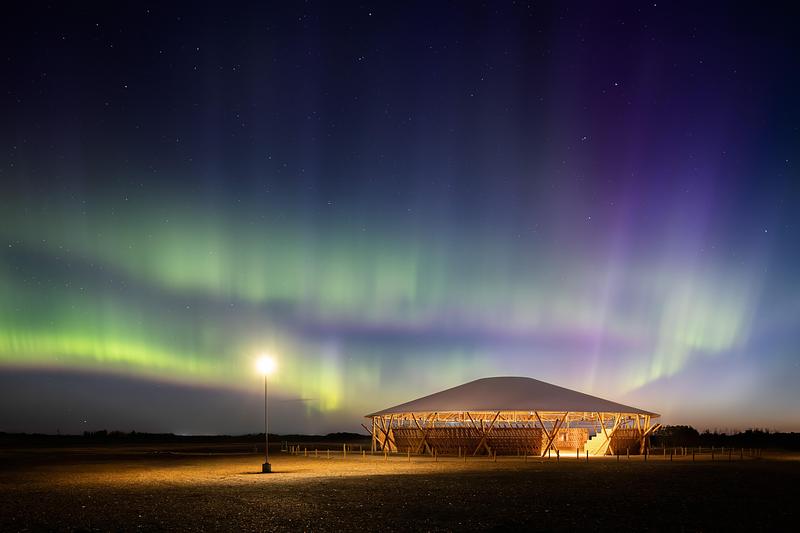
Image très haute résolution : 27.14 x 18.09 @ 300dpi ~ 5,6 Mo
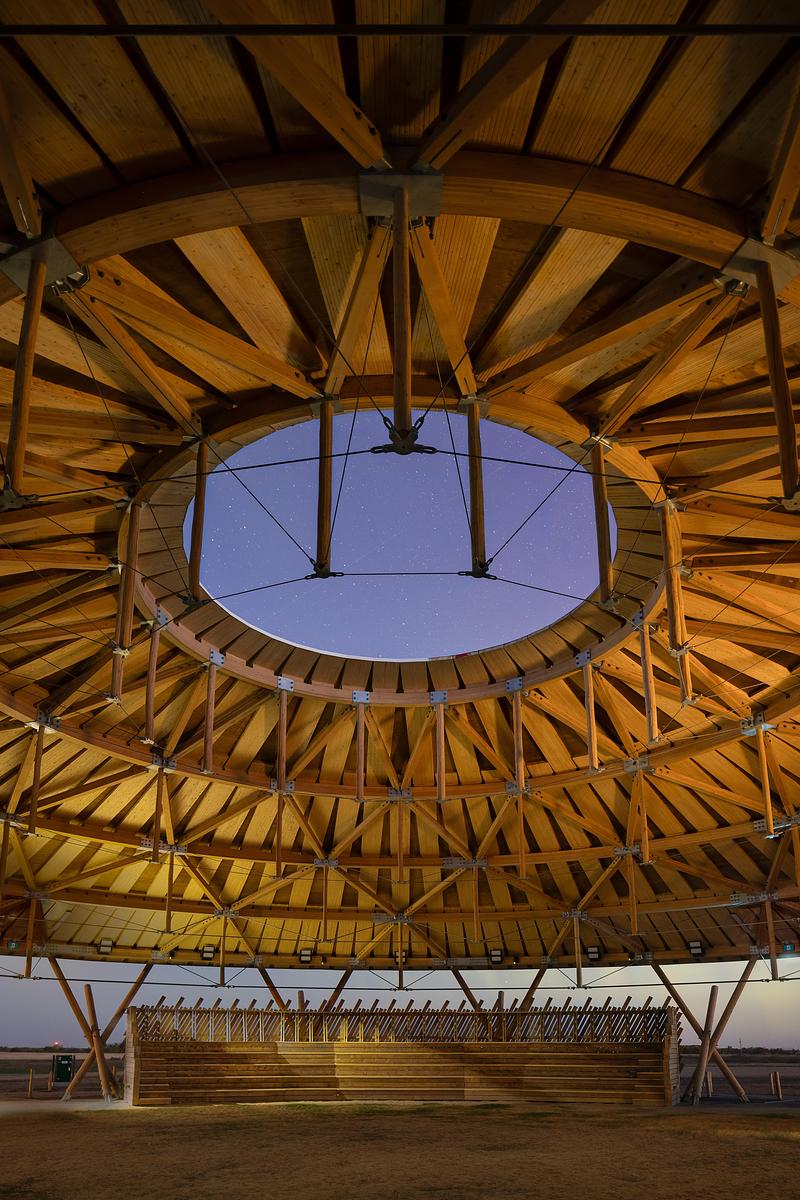
Interior image of Arbour at twilight with stars seen through the oculus
Image très haute résolution : 17.82 x 26.73 @ 300dpi ~ 10 Mo
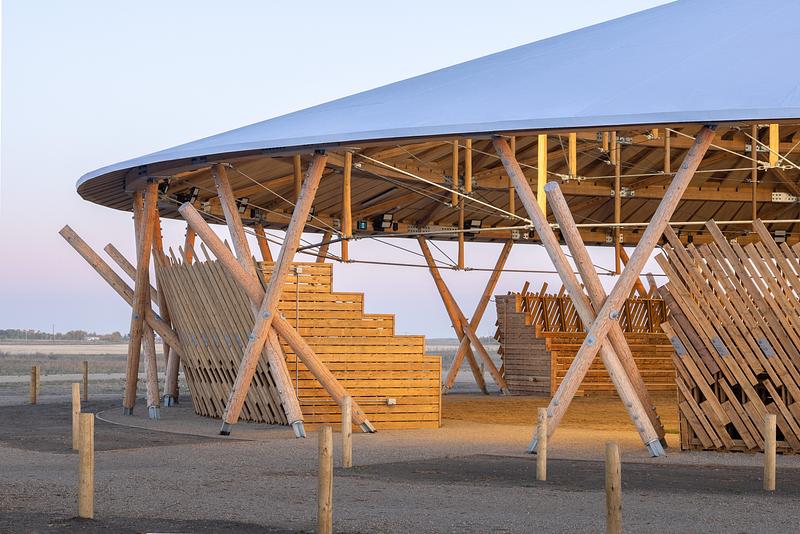
Exterior image of Arbour at daybreak showing bleacher screening
Image très haute résolution : 27.31 x 18.21 @ 300dpi ~ 12 Mo
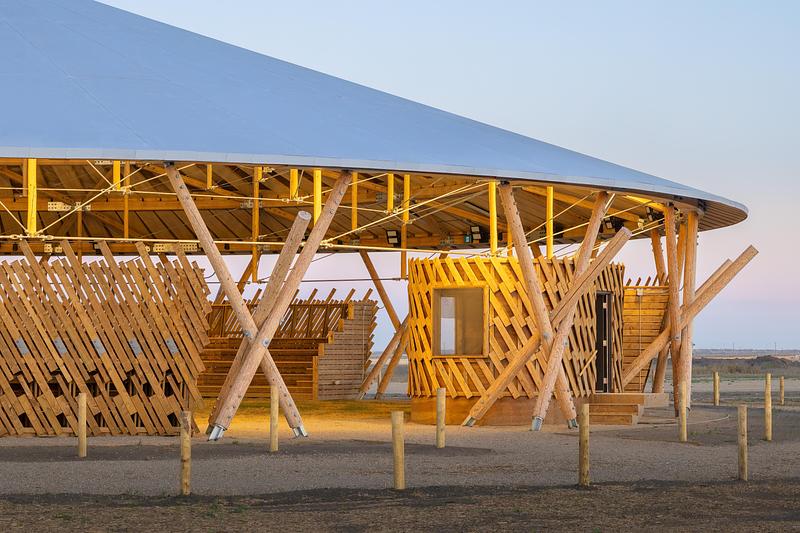
Exterior image of Arbour at daybreak showing announce booth and grand entry
Image très haute résolution : 24.13 x 16.1 @ 300dpi ~ 11 Mo
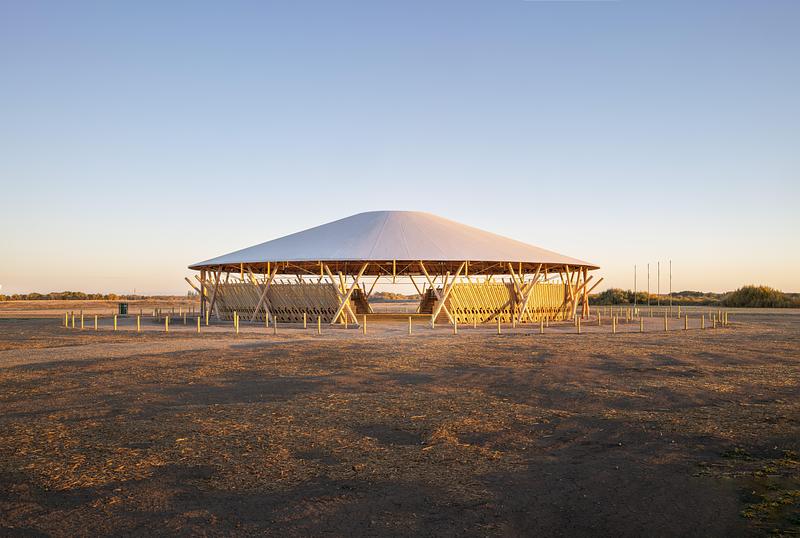
Exterior image of Arbour at daybreak looking directly north through structure’s
secondary entry
Image très haute résolution : 43.43 x 29.19 @ 300dpi ~ 24 Mo
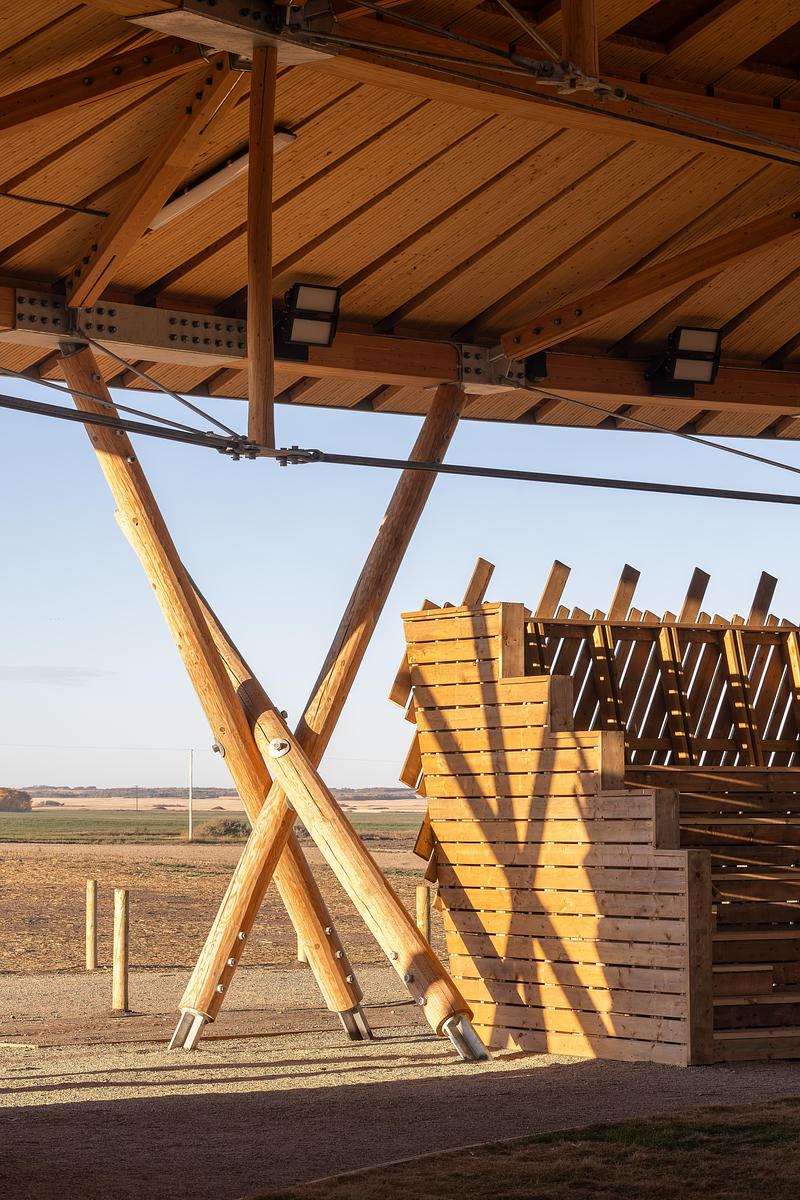
Interior image of Arbour showing structural round timber tripod
Image très haute résolution : 16.98 x 25.46 @ 300dpi ~ 14 Mo
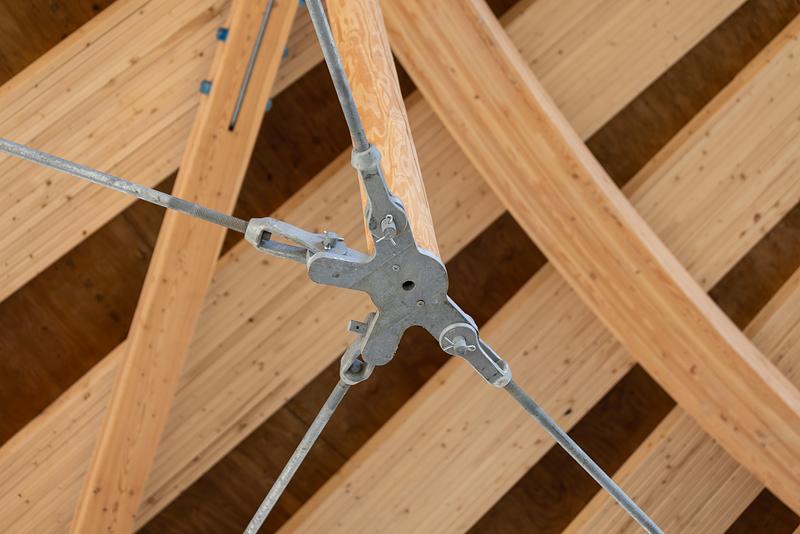
Interior image of Arbour showing structural round timber strut and cable system
connection
Image très haute résolution : 27.31 x 18.21 @ 300dpi ~ 6,6 Mo
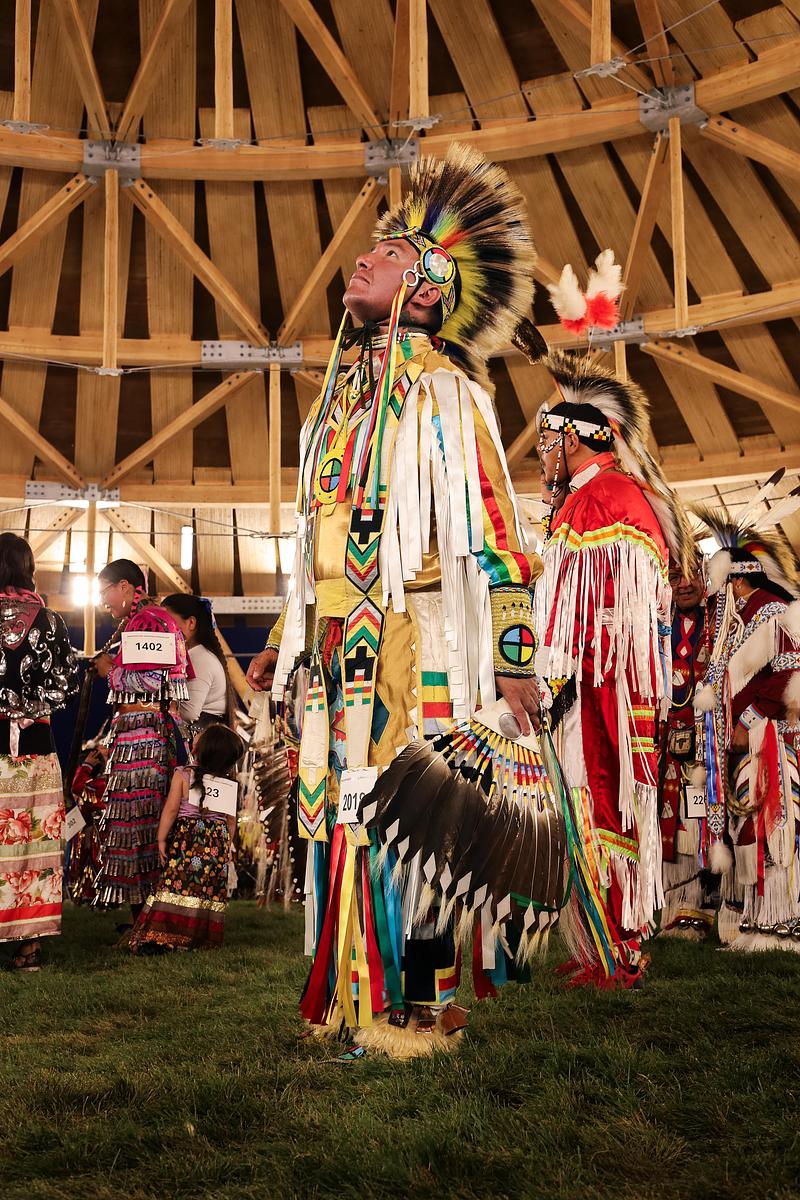
Image très haute résolution : 13.87 x 20.8 @ 300dpi ~ 7,6 Mo
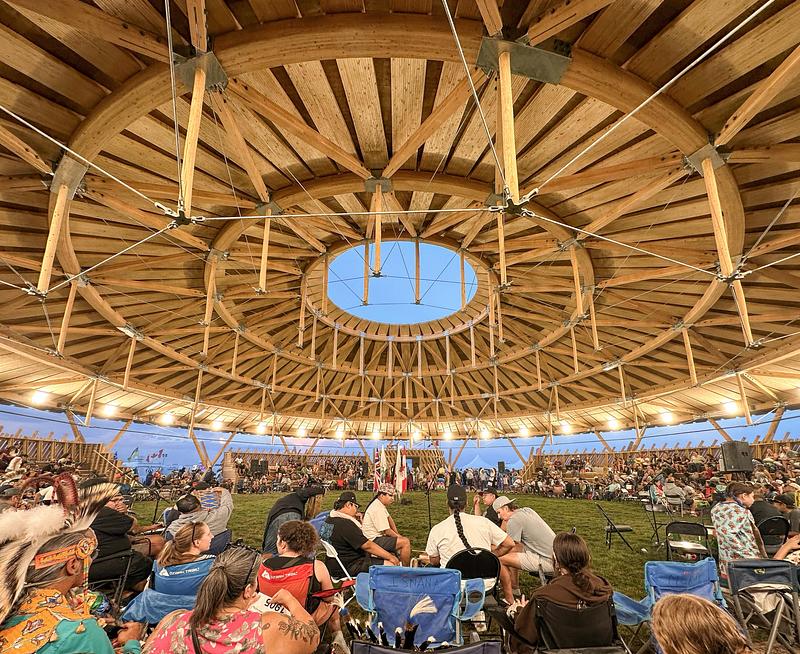
Image haute résolution : 14.67 x 11.99 @ 300dpi ~ 12 Mo
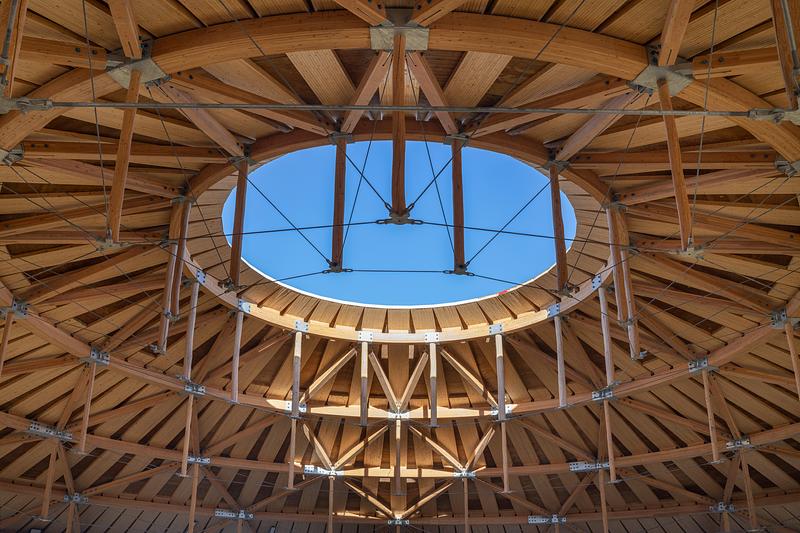
Interior image of Arbour with sunlight through the oculus
Image très haute résolution : 40.22 x 26.8 @ 300dpi ~ 18 Mo
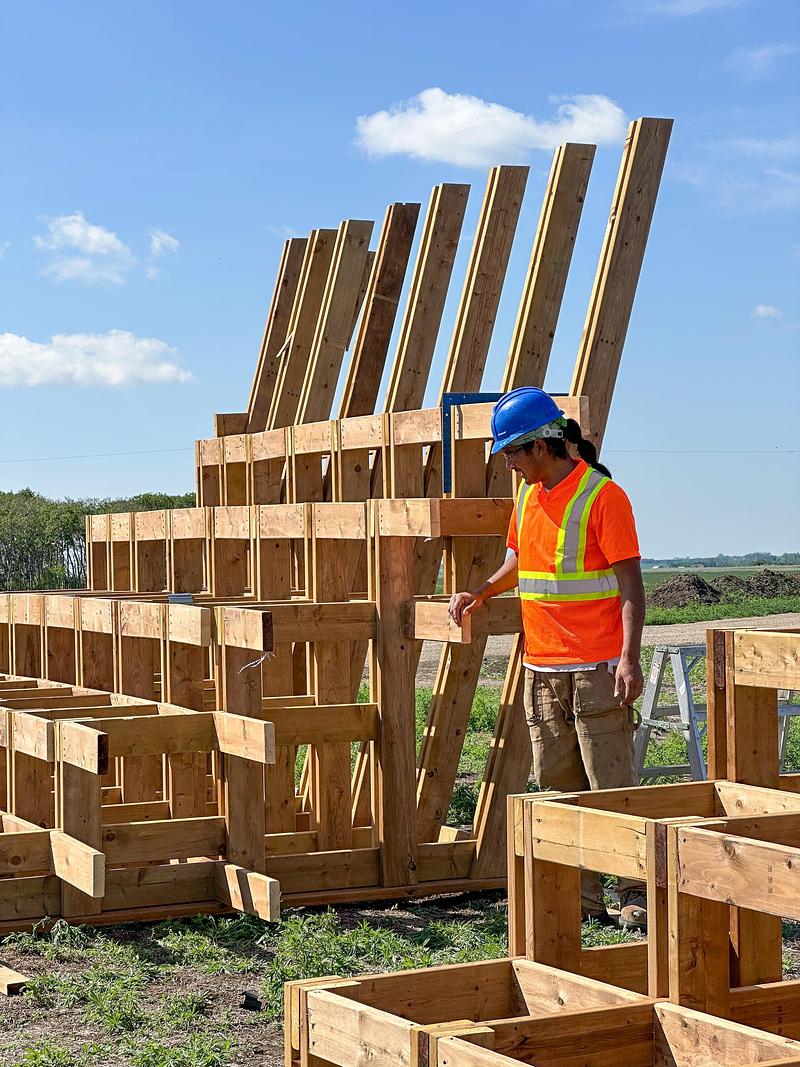
Image haute résolution : 10.08 x 13.44 @ 300dpi ~ 7,3 Mo
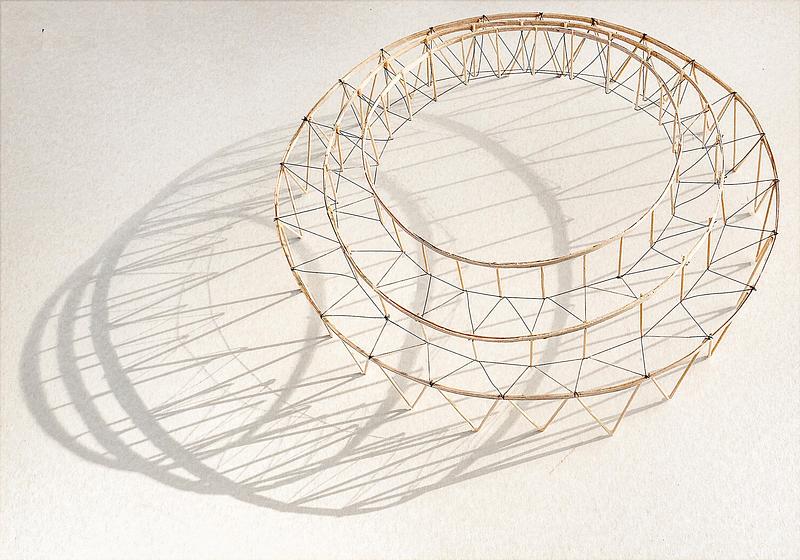
Image moyenne résolution : 10.0 x 7.0 @ 300dpi ~ 4,3 Mo

Publicité
Vous pourriez également aimer...
Montréal, Canada, 10-09-2026
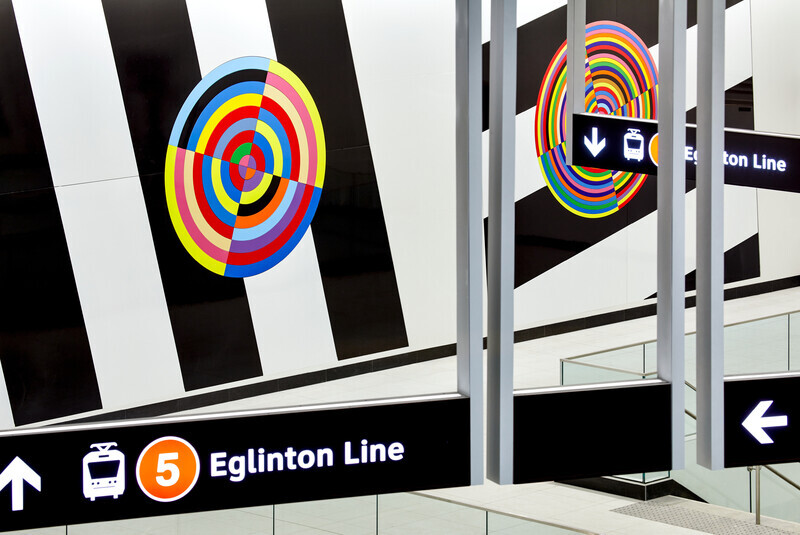
Eglinton Crosstown LRT : Rehausser la qualité du design dans l'espace public
Daoust Lestage Lizotte Stecker Benech
Los Angeles, États-Unis, 02-09-2026
StudioHAU parachève la rénovation majeure et le réaménagement complet du rez-de-chaussée du Berkshire Museum
StudioHAU
Toronto, Canada, 12-08-2026
Le bâtiment des sciences de la vie et la serre de l’Université McMaster
Moriyama Teshima Architects
Philadelphia, États-Unis, 12-08-2026
VMA redonne vie au Cresson Hall de l’université Lincoln
Voith & Mactavish Architects, LLP (VMA)
Toronto, Canada, 30-07-2026
Centre de recherche sur les abeilles de l'Université de Guelph
Moriyama Teshima Architects
Singapore, Singapour, 24-07-2026
La Central Manpower Base (CMPB) de DP Architects récompensée aux Architizer A+ Awards 2026
DP Architects
Johannesburg, Afrique du Sud, 20-07-2026